Regular boundaries#
See/run the test_2_generic_deck.py for an example where expreccs is used in two given models (regional and site, in this case they are created using the expreccs package, but in general can be any given geological models), generating a new input deck where the pressures are projected.
expreccs -i 'path_to_the_regional_model path_to_the_site_model'
For example, to run the test, this can be achieved by executing:
pytest --cov=expreccs --cov-report term-missing tests/test_2_generic_deck.py
To visualize/compare results between the model with static (input) and dynamic (generated by expreccs) boundary conditions, we can use our friend plopm:
plopm -i 'tests/configs/rotate/simulations/site_closed/SITE_CLOSED tests/configs/rotate/simulations/expreccs/EXPRECCS tests/configs/rotate/simulations/reference/REFERENCE' -v sgas -s ',,1 ,,1 ,,1' -sg 1,3 -st 0 -cbp 0.2,0.95,0.6,0.02 -fs 24,8 -cbf .1f -fz 20 -xu km -yu km -xf .0f -yf .0f -x '[0,15000]' -y '[0,15000]' -rdl 1
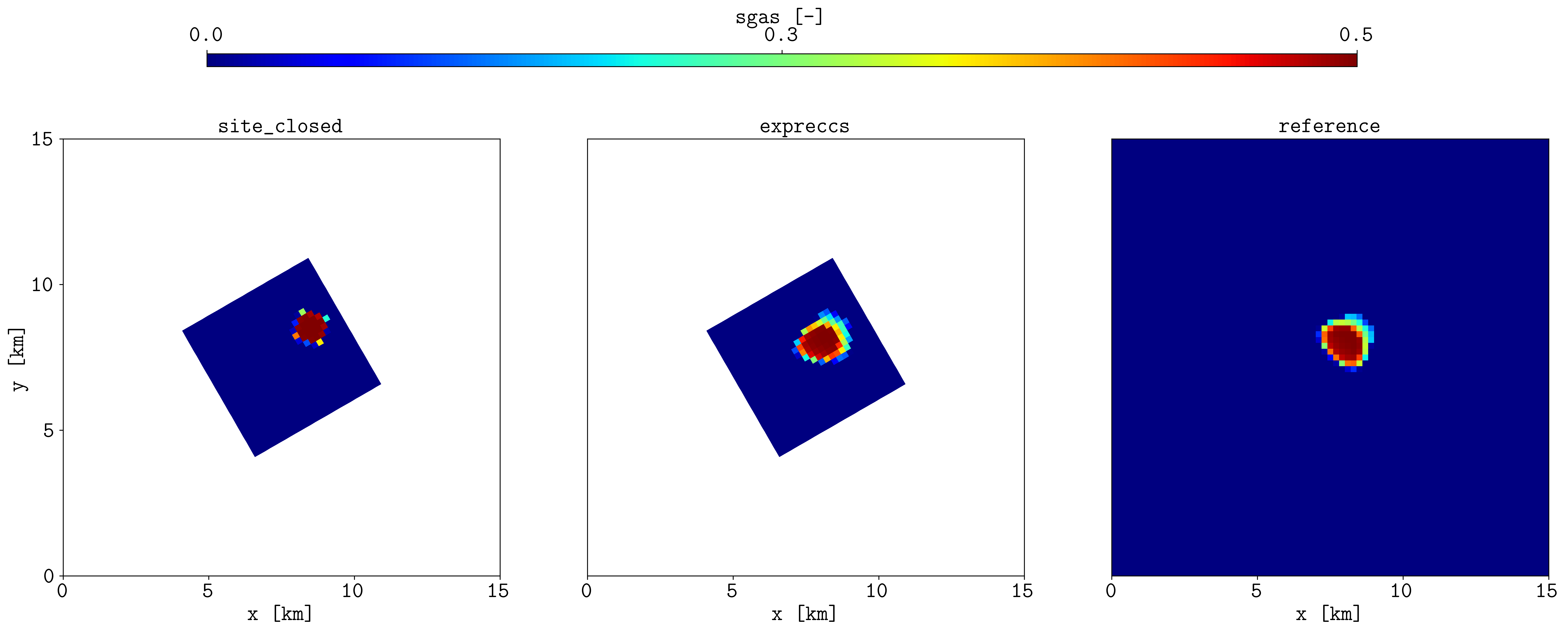
Comparison of the gas saturation on the top cells at the end of the simulations.#
Tip
You can install plopm by executing in the terminal:
pip install git+https://github.com/cssr-tools/plopm.git
See also the test_4_site_regional.py, where the two-stage approach is demonstrated in a site and regional deck generated using sandwich.toml. In this test the functionality to select if the boundary-condition mappings are written per fipnums, i.e., if there is an offset between the site and regional models along the z direction, then using -z 1 builds the interpolators per corresponding fipnums in the regional and site models. In addition, the flag -e 0 sets the interpolators to be defined by pressure increase and not by pressure values. If you run that test, then using plopm:
plopm -i 'tests/regional/REGIONAL tests/expreccs/EXPRECCS tests/expreccs_dpincrease/EXPRECCS_DPINCREASE tests/expreccs_perfipnum/EXPRECCS_PERFIPNUM' -v rpr:3 -sp 1
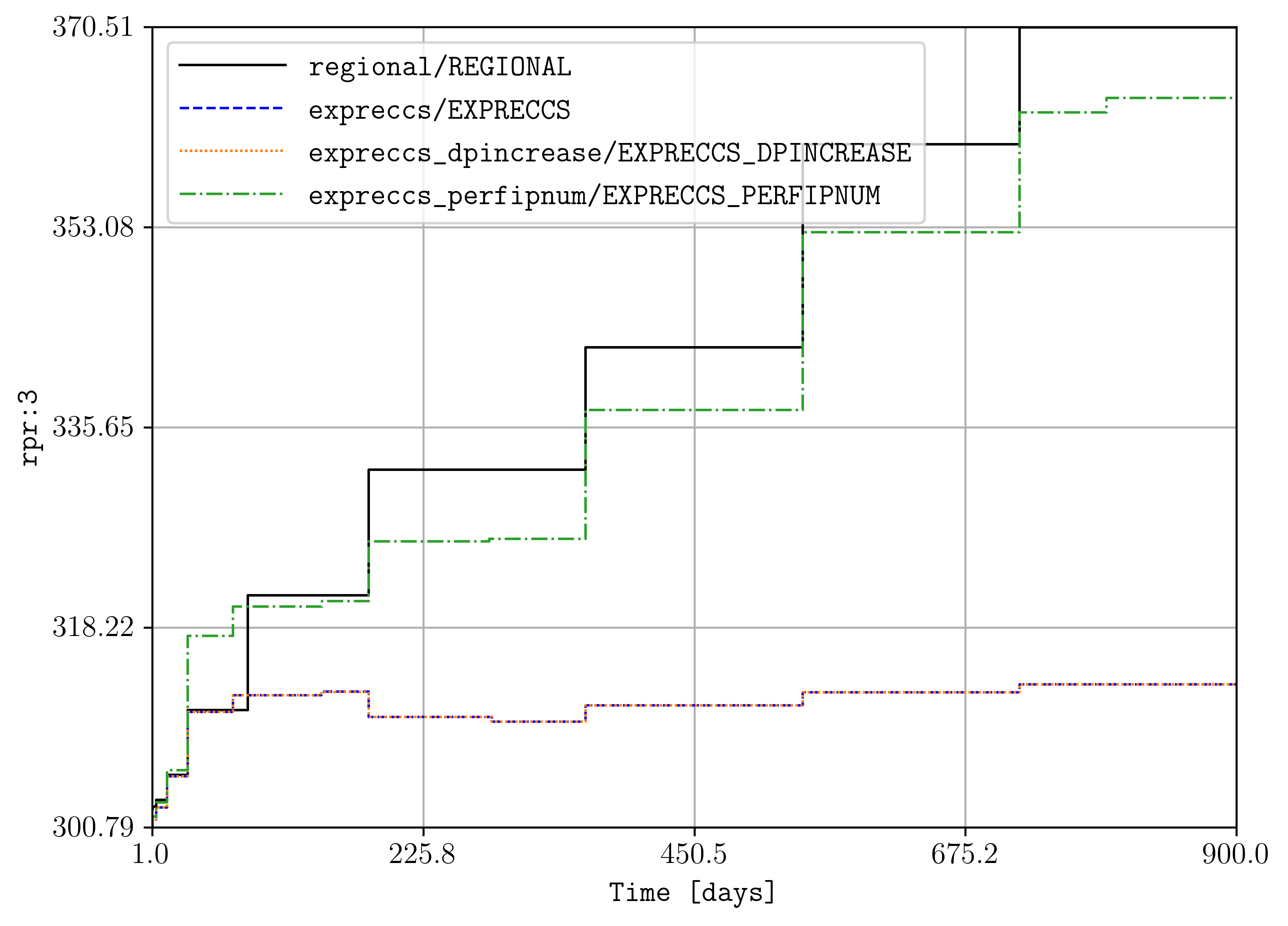
Comparison of the different functionality to map the dynamic boundary conditions. Here, rpr:3 (fipnum equal to 3) corresponds to the top part of the sandwich (three layers with the middle layer inactive) in the regional model, while to the bottom part in the site model.#
Reproduce the example#
Run the maintained script from the repository root:
. ./tests/scripts/docs_regular_boundaries.sh