pymm.core.pymm module#
Command-line entry point and top-level workflow coordination for pymm.
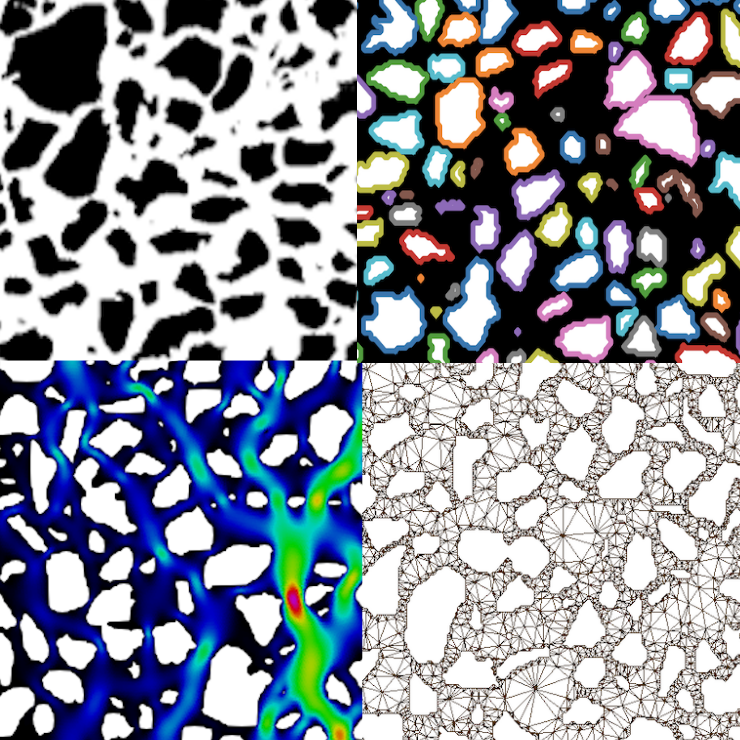
pymm supports four connected workflows for microsystem models:
Image processing segments grains, voids, and the external boundary.
Mesh generation creates Gmsh geometry and mesh files.
Flow simulation runs a steady incompressible OpenFOAM model.
Tracer simulation runs transient transport using the computed flow field.
This module parses and validates command-line arguments and TOML parameters, processes images, extracts and tags boundaries, writes mesh input, dispatches the selected simulations, and reports generated files. It also provides the shared terminal helpers used for errors, progress messages, and successful results.
- class pymm.core.pymm.PymmConfig(length: float, width: float, thickness: float, grainMeaning: int, threshold: float, rescale: float, grainsSize: int, borderTol: float, grainsTol: float, lineWidth: float, channelWidth: float, meshSize: float, viscosity: float, diffusion: float, inletLocation: str, inletValue: float, tracerTime: float, tracerWrite: float, pressureConv: float, velocityConv: float, iterationsMax: int, tracerStep: float)[source]#
Bases:
objectStore the shared pymm configuration loaded from TOML.
The top-level TOML values populate this frozen data class. The configuration is validated by
check_toml()and then shared by the image, mesh, flow, and tracer workflows.- Attributes:
- lengthfloat
Physical length used to scale the Gmsh geometry.
- widthfloat
Physical width used to scale the Gmsh geometry.
- thicknessfloat
Extrusion thickness used by the Gmsh template.
- grainMeaningint
Grain convention:
0for light grains or1for dark grains.- thresholdfloat
Grayscale segmentation threshold in the closed interval
[0, 1].- rescalefloat
Positive image rescaling factor.
- grainsSizeint
Maximum size, in pixels, of small grain objects to remove.
- borderTolfloat
Polygon-approximation tolerance for the external boundary.
- grainsTolfloat
Polygon-approximation tolerance for interior grains.
- lineWidthfloat
Line width used in the diagnostic figures.
- channelWidthfloat
Channel width passed to the Gmsh template.
- meshSizefloat
Target mesh size passed to the Gmsh template.
- viscosityfloat
Viscosity written to the OpenFOAM physical properties.
- diffusionfloat
Tracer diffusion value written to the OpenFOAM case.
- inletLocationstr
Inlet side:
left,top,right, orbottom.- inletValuefloat
Inlet value written to the OpenFOAM pressure field.
- tracerTimefloat
End time for the tracer simulation.
- tracerWritefloat
Output interval for the tracer simulation.
- pressureConvfloat
Pressure convergence tolerance for the flow solver.
- velocityConvfloat
Velocity convergence tolerance for the flow solver.
- iterationsMaxint
Maximum number of steady-flow iterations.
- tracerStepfloat
Time step for the tracer simulation.
Notes
Physical units are defined by the Gmsh and OpenFOAM templates and must be consistent across the configuration.
- pymm.core.pymm._assign_boundary(point: NDArray[float64], start_index: int, number_of_segments: int, reference_value: float, coordinate_index: int, target: list[int], wall: list[int]) int[source]#
Assign contour segments to an opening or wall.
- Parameters:
- pointnumpy.ndarray
Closed boundary-point array.
- start_indexint
First segment index to inspect.
- number_of_segmentsint
Number of consecutive segments to classify.
- reference_valuefloat
Coordinate of the target image edge.
- coordinate_indexint
Coordinate column used for comparison.
- targetlist[int]
Target-boundary indices updated in place.
- walllist[int]
Wall-boundary indices updated in place.
- Returns:
- int
First segment index after the processed range.
- pymm.core.pymm._colorize(text: str, code: str, stream: object = <_io.TextIOWrapper name='<stderr>' mode='w' encoding='utf-8'>) str[source]#
Wrap text in an ANSI color sequence when supported.
- Parameters:
- textstr
Text to format.
- codestr
ANSI color code.
- streamobject, optional
Output stream used to determine color support.
- Returns:
- str
Colored or unchanged text.
- pymm.core.pymm._supports_color(stream: object = <_io.TextIOWrapper name='<stderr>' mode='w' encoding='utf-8'>) bool[source]#
Check whether an output stream supports ANSI colors.
- Parameters:
- streamobject, optional
Output stream to inspect.
- Returns:
- bool
Whether ANSI color output is enabled.
- pymm.core.pymm.boundary_tags_left_top(point: NDArray[float64], pl: NDArray[float64], pt: NDArray[float64], bl: float, bt: float, wall: list[int]) tuple[list[int], list[int], int][source]#
Assign boundary tags for the left and top edges.
- Parameters:
- pointnumpy.ndarray
Closed boundary-point array.
- plnumpy.ndarray
Left-boundary points.
- ptnumpy.ndarray
Top-boundary points.
- blfloat
Left reference coordinate.
- btfloat
Top reference coordinate.
- walllist[int]
Wall indices updated in place.
- Returns:
- tuple[list[int], list[int], int]
Left tags, top tags, and the first unprocessed segment index.
- pymm.core.pymm.boundary_tags_right_bottom(point: NDArray[float64], start_index: int, pr: NDArray[float64], pb: NDArray[float64], bb: float, br: float, wall: list[int]) tuple[list[int], list[int]][source]#
Assign boundary tags for the right and bottom edges.
- Parameters:
- pointnumpy.ndarray
Closed boundary-point array.
- start_indexint
First segment index to inspect.
- prnumpy.ndarray
Right-boundary points.
- pbnumpy.ndarray
Bottom-boundary points.
- bbfloat
Bottom reference coordinate.
- brfloat
Right reference coordinate.
- walllist[int]
Wall indices updated in place.
- Returns:
- tuple[list[int], list[int]]
Right and bottom boundary tags.
- pymm.core.pymm.check_cmdargs(cmdargs: Namespace) None[source]#
Validate command-line values and incompatible operations.
Validation covers required paths, file extensions, mode-dependent image input, and Gmsh availability for workflows that generate a mesh.
- Parameters:
- cmdargsargparse.Namespace
Parsed command-line arguments.
- Raises:
- SystemExit
If an input value is invalid or a required executable is unavailable.
- pymm.core.pymm.check_toml(cfg: PymmConfig) None[source]#
Validate the TOML configuration values.
- Parameters:
- cfgPymmConfig
Shared runtime configuration.
- Raises:
- SystemExit
If a value has an invalid type, range, or accepted value.
- pymm.core.pymm.cli_correct_value(value: str) str[source]#
Format a valid CLI option or value.
- Parameters:
- valuestr
Accepted option, value, or example.
- Returns:
- str
Quoted value, colored green when supported.
- pymm.core.pymm.cli_error_value(value: str) str[source]#
Format an invalid CLI option or value.
- Parameters:
- valuestr
Option or value to format.
- Returns:
- str
Quoted value, colored red when supported.
- pymm.core.pymm.cli_info_value(value: str) str[source]#
Format an informational CLI option or value.
- Parameters:
- valuestr
Option or value to format.
- Returns:
- str
Quoted value, colored blue when supported.
- pymm.core.pymm.copy_and_replace(src: Path, dst: Path, replacements: dict[str, Any]) None[source]#
Copy a text template and replace its placeholders.
- Parameters:
- srcpathlib.Path
Source template file.
- dstpathlib.Path
Destination file.
- replacementsdict[str, Any]
Literal placeholders and replacement values.
- pymm.core.pymm.extract_borders(boundary: NDArray[float64]) tuple[NDArray[float64], NDArray[float64], NDArray[float64], NDArray[float64], float, float, float, float][source]#
Split the external contour into four image boundaries.
- Parameters:
- boundarynumpy.ndarray
Closed contour in padded-image coordinates.
- Returns:
- tuple
Left, top, right, and bottom point arrays followed by the four reference coordinates used for boundary tagging.
- pymm.core.pymm.main(argv: list[str] | None = None) None[source]#
Run the pymm command-line workflow.
Parse and validate CLI arguments and TOML parameters, then dispatch the selected image, mesh, flow, and tracer operations.
- Parameters:
- argvlist[str] | None, optional
Arguments to parse instead of
sys.argv[1:]. This is primarily used by tests and programmatic callers.
- Raises:
- SystemExit
If command-line or TOML validation fails.
- tomllib.TOMLDecodeError
If the parameter file is not valid TOML.
- subprocess.CalledProcessError
If an external command fails.
- pymm.core.pymm.make_figures(cfg: PymmConfig, fol: Path, im: NDArray[bool], border: NDArray[bool], cn_grains: list[NDArray[float64]], cn_border: list[NDArray[float64]]) NDArray[float64][source]#
Create diagnostic figures for the grains and external boundary.
- Parameters:
- cfgPymmConfig
Shared runtime configuration.
- folpathlib.Path
Output directory for generated figures.
- imnumpy.ndarray
Padded binary image.
- bordernumpy.ndarray
Boolean mask containing the external border.
- cn_grainslist[numpy.ndarray]
Interior-grain contours in
(row, column)order.- cn_borderlist[numpy.ndarray]
Candidate external-boundary contours.
- Returns:
- numpy.ndarray
Selected external boundary in reversed point order.
- pymm.core.pymm.pad_with(vector: NDArray[float64], pad_width: tuple[int, int], _iaxis: int, kwargs: dict) None[source]#
Fill NumPy padding regions with a constant value.
- Parameters:
- vectornumpy.ndarray
One-dimensional array view modified in place.
- pad_widthtuple[int, int]
Number of values padded before and after the original array.
- _iaxisint
Axis supplied by
numpy.pad(); unused.- kwargsdict
Callback options.
padderselects the fill value.
- pymm.core.pymm.parse_args(argv: list[str] | None = None) Namespace[source]#
Create the CLI parser and parse pymm arguments.
- Parameters:
- argvlist[str] | None, optional
Arguments to parse instead of
sys.argv[1:].
- Returns:
- argparse.Namespace
Parsed command-line arguments.
- pymm.core.pymm.process_image(cfg: PymmConfig, fol: Path, mode: str, in_image: str) tuple[int, int, list[NDArray[float64]], NDArray[float64]][source]#
Segment the input image and extract its contours.
Write diagnostic PNG files and return the rescaled dimensions, interior-grain contours, and external boundary.
- Parameters:
- cfgPymmConfig
Shared runtime configuration.
- folpathlib.Path
Output directory for generated figures.
- modestr
Microsystem setup,
imageordevice.- in_imagestr
Path to the input PNG image.
- Returns:
- tuple[int, int, list[numpy.ndarray], numpy.ndarray]
Image height, image width, grain contours, and external boundary.
- pymm.core.pymm.pymm_error(message: str) NoReturn[source]#
Raise a fatal pymm command-line error.
- Parameters:
- messagestr
Error message to display.
- Raises:
- SystemExit
Always raised with the formatted error message.
- pymm.core.pymm.pymm_info(message: str) None[source]#
Display an informational pymm message.
- Parameters:
- messagestr
Progress or workflow message.
- pymm.core.pymm.pymm_name(stream: object = <_io.TextIOWrapper name='<stderr>' mode='w' encoding='utf-8'>) str[source]#
Format the pymm program name.
- Parameters:
- streamobject, optional
Output stream used to determine color support.
- Returns:
- str
Formatted program name.
- pymm.core.pymm.pymm_success(msg: str, output_dir: str, filenames: list[str]) None[source]#
Display generated output files and locations.
- Parameters:
- msgstr
Optional success message.
- output_dirstr
Directory containing the generated files.
- filenameslist[str]
Generated filenames.
- pymm.core.pymm.run_stokes(cfg: PymmConfig, fol: Path, pat: Path) None[source]#
Write and run the steady incompressible-flow case.
Create the OpenFOAM case, convert the Gmsh mesh, run the flow solver, export VTK results, and copy them to the pymm output directory.
- Parameters:
- cfgPymmConfig
Shared runtime configuration.
- folpathlib.Path
Output directory containing
mesh.msh.- patpathlib.Path
Project root containing the OpenFOAM templates.
- Raises:
- SystemExit
If
gmshToFoamis unavailable.- subprocess.CalledProcessError
If an OpenFOAM command fails.
- pymm.core.pymm.run_tracer(cfg: PymmConfig, fol: Path, pat: Path) None[source]#
Write and run the transient tracer-transport case.
Create the OpenFOAM case, copy the latest flow fields and mesh, run the tracer solver, export VTK results, and copy them to the pymm output directory.
- Parameters:
- cfgPymmConfig
Shared runtime configuration.
- folpathlib.Path
Output directory containing a completed flow case.
- patpathlib.Path
Project root containing the OpenFOAM templates.
- Raises:
- SystemExit
If
topoSetis unavailable.- subprocess.CalledProcessError
If an OpenFOAM command fails.
- pymm.core.pymm.write_geo(cfg: PymmConfig, fol: Path, pat: Path, mode: str, gmsh: str, imH: int, imL: int, cn_grains: list[NDArray[float64]], pl: NDArray[float64], pt: NDArray[float64], pr: NDArray[float64], pb: NDArray[float64], bdnL: list[int], bdnT: list[int], bdnR: list[int], bdnB: list[int], wall: list[int]) None[source]#
Write the Gmsh geometry file and generate the mesh.
Convert image contours to Gmsh points and physical boundaries, render the mode-specific Mako template, and execute Gmsh.
- Parameters:
- cfgPymmConfig
Shared runtime configuration.
- folpathlib.Path
Output directory.
- patpathlib.Path
Project root containing the templates.
- modestr
Microsystem setup,
imageordevice.- gmshstr
Gmsh executable or command.
- imHint
Rescaled image height in pixels.
- imLint
Rescaled image width in pixels.
- cn_grainslist[numpy.ndarray]
Interior-grain contours.
- pl, pt, pr, pbnumpy.ndarray
Left, top, right, and bottom boundary points.
- bdnL, bdnT, bdnR, bdnBlist[int]
Segment indices for the physical boundaries.
- walllist[int]
Segment indices for wall boundaries.
- Raises:
- subprocess.CalledProcessError
If Gmsh exits with a nonzero status.